
Today, we are announcing that Multicoin led a $4 million seed round in Birch Hill, a vertically integrated onchain credit platform that connects institutional credit supply and stablecoin-denominated demand.
Credit is the oldest method of capital formation in history, and it is inherently a trust and coordination problem. For much of its existence, credit has been an integrated process: banks would originate, fund, and service loans end-to-end. Over the last fifty years however, credit has been disintermediated across a supply chain of specialists.
Jim Barksdale once said, “There are only two ways I know of to make money in business: bundling and unbundling.”
Across industries, there are moments when the cost of coordinating separate firms outweighs the gains from outsourcing and specialization, creating an opportunity to compete asymmetrically by bringing those functions back together. Automaking went from Ford’s Rouge complex to specialist suppliers serving many manufacturers, before Tesla brought battery and vehicle design under under one roof. Computing went from IBM’s integrated systems to PCs built around Intel and Microsoft, before Apple brought chip design in-house alongside its hardware and software.
Credit is approaching a moment of rebundling. We believe that the next generation of great credit institutions will be both integrated and onchain.
Today, a new credit platform can build on shared lending and settlement infrastructure, and concentrate its resources on deciding what deserves financing and routing the right capital to it. Bringing those decisions under one roof means the requirements of the allocator can inform the product from the beginning. Birch Hill is the purest expression of that opportunity we have seen.
The Unbundling
The bank was the original full-stack credit institution. The firm that knew the borrower structured the loan, priced it, held it on its balance sheet, and took responsibility for recourse when things went sideways. This was true of the Medici family lending to popes and monarchs in the fifteenth century, and was still true of J.P. Morgan reorganizing the railroads four hundred years later. Every piece of information about the credit lived in one place, and that institution was held accountable for the outcome.
The last half century took that bundle apart. Securitization, capital regulation, and the growth of non-bank lending split the bank into a mosaic of specialists: originators, rating agencies, servicers, dealers, asset managers, and the prime desks that finance them. Unbundling produced enormous scale, and credit grew into a $300+ trillion market, but it introduced serious costs. Every handoff in the supply chain created information and efficiency losses.
In any arrangement, a lender needs to understand whether a borrower can repay and what recourse they have if the borrower defaults. A borrower taking on an obligation needs to understand where the capital is coming from and whether they can rely on it. Everything this asset class has built around itself (from underwriting and covenants to ratings and reporting and recovery) exists so that we can collectively create a marketplace for both sides.
As a result, the system overcompensates with standardization (conforming documents, ratings, representations and warranties). Today, the person pricing the risk sits several hops away from the person who underwrote the borrower, who sits several hops away from the the servicer responsible for collecting payments and handling defaults. This is an inherently lossy process, tends to work well for assets this supply chain already understands and poorly for anything it has not seen before.
RWA lending in DeFi has inherited this structure and run it to its logical conclusion. A single onchain credit market today is assembled from a lending protocol, a curator, an oracle provider, a custodian, a compliance vendor, and a stablecoin issuer; i.e., several separate firms with their own incentives. Financing less liquid assets requires someone to underwrite the borrower and establish how capital can be recovered outside the protocol. Teams like Ethena and Spark have begun allocating onchain dollars to offchain credit facilities, but there remains an enormous opportunity to make this process repeatable and bring a much broader range of credit to market.
The Rebundling
Banks bundled two things: the plumbing of credit and the judgment around it. Today, credibly neutral blockchains have commoditized the plumbing. Settlement and lending execution can run on permissionless protocols. What remains scarce is judgment. What deserves financing, how it should be structured, and whose capital should fund and service it? These legal and operational responsibilities extend beyond the protocol. A new credit institution can own those decisions end to end.
Consider a specialty lender financing apartment buildings. It needs capital to keep originating, so it retains the junior position that absorbs losses first and sells senior notes to investors with a different appetite for risk. Those investors, in turn, may want to borrow against the notes they own or access liquidity opportunistically.
In a fragmented market, each of those steps happens across different firms. A note that looks attractive to an investor may still be difficult to borrow against if its reporting or redemption terms do not meet the financing desk's requirements. Discovering that mismatch after issuance can make financing expensive or leave the investor with an asset it cannot easily finance or offload. Specialization lets each firm develop deeper expertise and spread its costs across many clients, but each handoff adds cost or prevents the transaction altogether.
Birch Hill's ambition is to bring those decisions under one roof, so the team assessing the credit also has a say in how it gets structured and financed. It starts with the issuer, advising on whether and how an asset should come onchain, which is how the firm wins the relationship and defines the credit box. It builds the onchain lending market around the asset, so the firm assessing collateral eligibility can help shape the credit structure alongside the loan originator. It also plans to structure and place the credit through a securities business and raise pools of managed capital to invest in the products.
Birch Hill takes the view that owning the full stack creates compounding returns. Infrastructure built for the first transaction can be reused for the next, and the originator can return with its next pool of loans instead of assembling the process again.
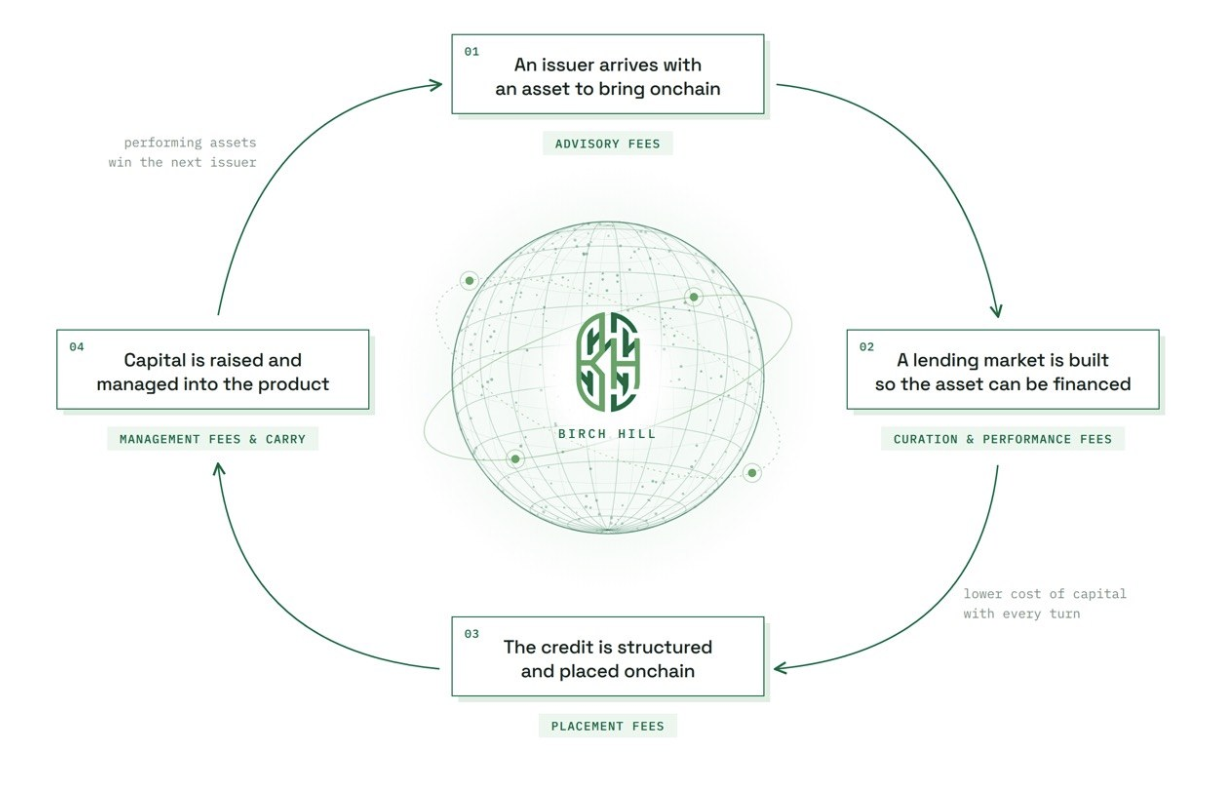
Birch Hill earns fees when an asset is issued and recurring fees on the capital it manages into that asset. Over time, we expect a firm that owns both the issuer relationship and the relationship with capital to develop a substantial advantage: more consistent issuance gives investors a reason to trust the platform, and more dependable capital gives originators a reason to be repeat customers. The work required for each financing can decline as diligence is reused, while demonstrated asset performance and a deeper investor base may support lower funding costs and better net returns after fees.
The Credit Curve
Birch Hill's Groma market is the first example of the system in action. Eligible holders of tokenized real-estate equity can borrow USDC against their holdings through Morpho. Birch Hill designed the market’s lending parameters around the equity’s valuation and redemption terms, alongside the restrictions governing who can participate.
This is an early approach that demonstrates how onchain primitives can service a much wider range of credit products. Much of early DeFi lending was organized around assets that could be liquidated immediately. In contrast, a loan against a building gets repaid over time, and recovering money from a default can take months or years. Financing it requires capital whose terms accommodate that duration and cashflow profile. Put plainly, an investor willing to commit for two years can fund a different obligation than one who needs money next week.
An integrated credit institution can match capital to different stages of a loan’s life. Birch Hill is building its onchain issuance of tokenized credit securities (oABS) around this idea. Lenders seeking shorter exposure can fund revolving credit lines to originators, with a transparent credit box defining which loans qualify and a takeout process through which those loans are sold to longer-term investors. When the loans are sold, the proceeds repay the facility and free capacity to finance the next pool. Investors with longer time horizons can hold securities backed by those loans and receive cash flows as borrowers repay. Coordinating the initial financing and the eventual placement gives an originator access to both pools of capital, each with a different investment horizon. As these products develop, onchain capital markets can support a credit curve, with financing available across maturities and risk.
The assets can also become useful elsewhere onchain. An investor could own a note for its income and borrow against it when the right financing is available or sell it when liquidity is matched. Clear claims on the underlying cash flows and reliable information about their performance make this capital rehypothecation easier to underwrite, and this in turn expands the pool of capital willing to own the asset in the first place.
This is where the rebundled institution is superior: a bank's information stayed inside its walls, while onchain credit platforms are public, transparent, and composable. Shared onchain records can make positions easier to verify and finance across approved counterparties, even when borrower information remains private and transfers are restricted.
Onshore by Design
The last generation of onchain credit was structured around exemptions, built offshore to stay away from the US buyer and the US regulators, and institutional capital stayed away in kind. Now, institutional capital is starting to enter onchain credit, and the evolving U.S. framework creates room for firms built specifically to serve that market. Birch Hill is making the timely bet: build a US-regulated, onchain-native credit institution while the framework evolves, and acquire the licensure, trust, and brand necessary to build the next enduring credit institution. Running a curator, a securities business, and an asset manager under one roof means carrying three regulatory burdens at once, and carrying them in the United States. We have known and admired founder and CEO Bhavin Vaid for years, and see tremendous founder-market fit in the business. Bhavin originated structured credit at Goldman Sachs and invested at Cerberus before moving to digital assets at 10T Holdings. His cofounders, Connor Flanagan and Jack Forlines built risk systems on BlackRock's Aladdin platform before spending years in onchain markets.
Rebundling credit requires judgment and access, and we believe the Birch Hill team has both in spades. We are thrilled to partner with them.

/Compute Capital Markets

Compute is the fastest growing asset class in the world. Over the last few years, there has been an extraordinary amount written about the datacenter buildout, the capital expenditure required to finance token factories of all sizes.
Disclosure: Unless otherwise indicated, the views expressed in this post are solely those of the author(s) in their individual capacity and are not the views of Multicoin Capital Management, LLC or its affiliates (together with its affiliates, “Multicoin”). Certain information contained herein may have been obtained from third-party sources, including from portfolio companies of funds managed by Multicoin. Multicoin believes that the information provided is reliable and makes no representations about the enduring accuracy of the information or its appropriateness for a given situation. This post may contain links to third-party websites (“External Websites”). The existence of any such link does not constitute an endorsement of such websites, the content of the websites, or the operators of the websites.These links are provided solely as a convenience to you and not as an endorsement by us of the content on such External Websites. The content of such External Websites is developed and provided by others and Multicoin takes no responsibility for any content therein. Charts and graphs provided within are for informational purposes solely and should not be relied upon when making any investment decision. Any projections, estimates, forecasts, targets, prospects, and/or opinions expressed in this blog are subject to change without notice and may differ or be contrary to opinions expressed by others.
The content is provided for informational purposes only, and should not be relied upon as the basis for an investment decision, and is not, and should not be assumed to be, complete. The contents herein are not to be construed as legal, business, or tax advice. You should consult your own advisors for those matters. References to any securities or digital assets are for illustrative purposes only, and do not constitute an investment recommendation or offer to provide investment advisory services. Any investments or portfolio companies mentioned, referred to, or described are not representative of all investments in vehicles managed by Multicoin, and there can be no assurance that the investments will be profitable or that other investments made in the future will have similar characteristics or results. A list of investments made by venture funds managed by Multicoin is available here: https://multicoin.capital/portfolio/. Excluded from this list are investments that have not yet been announced due to coordination with the development team(s) or issuer(s) on the timing and nature of public disclosure. Separately, for strategic reasons, Multicoin Capital’s hedge fund does not disclose positions in publicly traded digital assets.
This blog does not constitute investment advice or an offer to sell or a solicitation of an offer to purchase any limited partner interests in any investment vehicle managed by Multicoin. An offer or solicitation of an investment in any Multicoin investment vehicle will only be made pursuant to an offering memorandum, limited partnership agreement and subscription documents, and only the information in such documents should be relied upon when making a decision to invest.
Past performance does not guarantee future results. There can be no guarantee that any Multicoin investment vehicle’s investment objectives will be achieved, and the investment results may vary substantially from year to year or even from month to month. As a result, an investor could lose all or a substantial amount of its investment. Investments or products referenced in this blog may not be suitable for you or any other party. Valuations provided are based upon detailed assumptions at the time they are included in the post and such assumptions may no longer be relevant after the date of the post. Our target price or valuation and any base or bull-case scenarios which are relied upon to arrive at that target price or valuation may not be achieved.
Multicoin has established, maintains and enforces written policies and procedures reasonably designed to identify and effectively manage conflicts of interest related to its investment activities. For more important disclosures, please see the Disclosures and Terms of Use available at https://multicoin.capital/disclosures and https://multicoin.capital/terms.