RWAs Are Just Built Different


This is our third essay in a series about onchain markets. In our first post, we covered application controlled execution (ACE) and how it can create new ways for tokens to capture value. The second essay discussed adverse selection in DeFi and models for protecting against it.
For most of DeFi’s history, activity remained mostly self-referential and endogenous to the crypto ecosystem. People traded crypto for crypto, borrowed crypto using other crypto as collateral, and built derivatives based on crypto prices. Even the biggest onchain markets, like spot DEXs, lending platforms, and perpetuals, all focused on a small group of native tokens. This wasn’t a deliberate design, but rather a limitation because early DeFi could only use assets that were already onchain.
This constraint influenced how DeFi developed. Liquidity for long-tail tokens was built up using AMMs, and the industry spent years iterating on AMM market structure. This was useful for internal crypto trading, but it probably won’t work for real-world assets (RWAs), where liquidity, price discovery, and risk management are handled differently, and makers are willing to quote tight.
Borrow/lend followed a similar pattern. Platforms like Aave and Compound required borrowers to put up much more collateral than they borrowed and used strict liquidations with no ability for a margin call top-up since the assets are volatile, don’t generate cash flow, and have no legal protections. None of this is particularly relevant for the vast majority of RWAs.
Paul Atkins, the SEC Chairman, has repeatedly stated that U.S. financial markets and the broader financial system are poised to move on-chain through tokenization, predicting that this shift (including for stocks, bonds, derivatives) could happen “within two years." We believe that the next wave of growth in DeFi is going to be driven by RWAs, defined as assets that are exogenous to the crypto ecosystem. TradFi transacts trillions of dollars per day across FX, rates, equities, and commodities, and crypto is orders of magnitude smaller. We believe that blockchain rails are far more efficient for trading these assets (as we’ll expand on below), and they create a single hub where users can trade any asset for any other asset, cheaply, globally, 24/7, and with strong settlement guarantees.
A Bit of History First
Since the advent of crypto, there’s been a recurring ambition to bring traditional financial assets onto blockchain rails. Equities, credit, commodities, real estate, and other assets have been “about to move on chain” for seemingly a decade at this point.
The first major wave of RWA experimentation happened between 2016-2018. Projects such as Polymath, Harbor, OpenFinance Network, Neufund, and others tried to tokenize real estate and securities directly on blockchains. While the idea made sense, the timing was early. Stablecoins were not yet widely used, onchain liquidity was limited, trading platforms were still developing, and there was no clear regulation for issuance, custody, or secondary trading. As a result, most of these platforms either closed their doors, pivoted, or became irrelevant.
The backdrop has changed materially. Today, stablecoins are widely used settlement assets, onchain market microstructure is improving and is clearing significant amounts of volume, institutional custody and compliance infrastructure now exists, and regulators are opening the door for experimentation. In the U.S., the GENIUS Act and CLARITY Act show that the current regulatory regime is welcoming and friendly to the industry, and we’re seeing a cambrian explosion of RWA activity as a result:
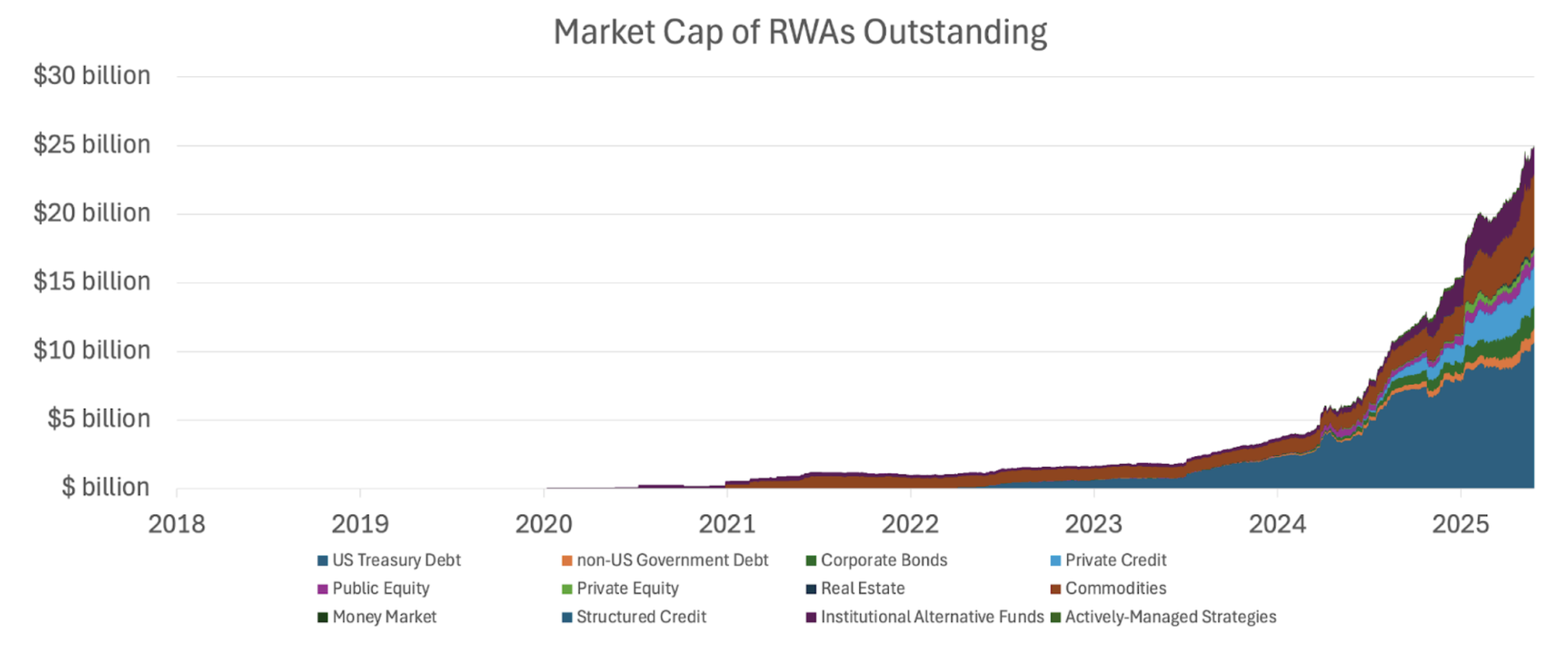 Source: rwa.xyz
Two Variables Matter for Onchain RWAs: Rights and Settlement
Before we break down which categories of assets are most likely to move onchain and how, it helps to understand two key variables for RWAs: 1) rights, and 2) settlement.
The first variable is the rights that come with holding a token. In some cases, the token doesn’t give you any direct claim to the asset itself; instead, it only provides economic exposure. For example, synthetic assets work this way. A token might track the price of a stock or commodity, but holders do not have any legal claim to the real asset, like a physically-settled derivative.
In other cases, the token gives a contractual claim on something offchain. Many tokenized treasury products work this way. Here, the token stands for a claim on a fund, SPV, or issuer that holds the real assets offchain.
At the other extreme, the token gives direct legal ownership of the asset itself. In this setup, the token acts as the digital version of the asset’s title with the blockchain serving as the system of record for the asset.
The second variable to consider is where assets settle. Many RWAs today use blockchains mainly for recordkeeping and distribution, but the real asset still settles through tradfi systems. For example, a tokenized treasury fund might issue tokens onchain, but the actual treasuries are held by custodians and settle in the usual way.
In other cases, the assets themselves can settle directly onchain. Synthetic perps are the clearest example of this model. When a perp gets traded on an onchain venue, collateral actually moves back and forth between longs and shorts.
This difference is important because settlement decides where the main record is kept. If settlement is offchain, the token just wraps a traditional asset. If it’s onchain, the blockchain becomes the main settlement layer.
There was recently an article on X about a downside case of having offchain settlement, specifically in the context of looping all sorts of RWAs. The basic claim here is that there must be redemption liquidity for people to exit, and for looping the settlement delays could cause users to miss out on specific opportunities. Today, this is generally handled by a vault curator but they have a cost of capital that eats returns.
Some assets will move onchain in ways that give users strong legal rights, but settlement will still be offchain. Others might offer only synthetic exposure and settle fully onchain. In the future, we might see models where both rights and settlement are fully onchain.
It’s important to understand these variables because they elucidate why RWAs won’t all move onchain the same way. Each RWA asset class will likely have its own legal setup, settlement process, and liquidity needs. So, the way they come onchain will be bespoke.
In addition, there are significant potential regulatory impacts on RWA models. The SEC weighed in on the issue of tokenized security models in an advisory in January. The SEC and CFTC are likely to weigh in on rules applicable to different forms of tokenized financial instruments, with design decisions impacting how these assets move, settle, white-list holders and transfer rights under Federal and state law.
In this post, we look at the various models for bringing RWAs onchain, explain why different asset classes will follow different paths across these dimensions, and explore path dependency therein.
Approaches to Bringing RWAs Onchain
There isn’t a well-defined standard for bringing RWAs onchain. We’ve seen a ton of experimentation around perps, prediction markets, custody wrappers, primary issuance, etc. Below, we categorize these approaches into four buckets and briefly highlight the trade-offs of each.
Model 1 - Synthetic Derivatives
Synthetic derivatives are everywhere in tradfi markets because many traders care more about having exposure to an asset than actually owning it. If a trader wants to speculate on Apple, they usually won’t seek out AAPL stock. Rather, they will try to attain straightforward exposure, efficient leverage, and want a clear process if they need to get out. The same goes for retail traders speculating on gold prices, treasury desks hedging FX risk, or pension funds tweaking their duration.
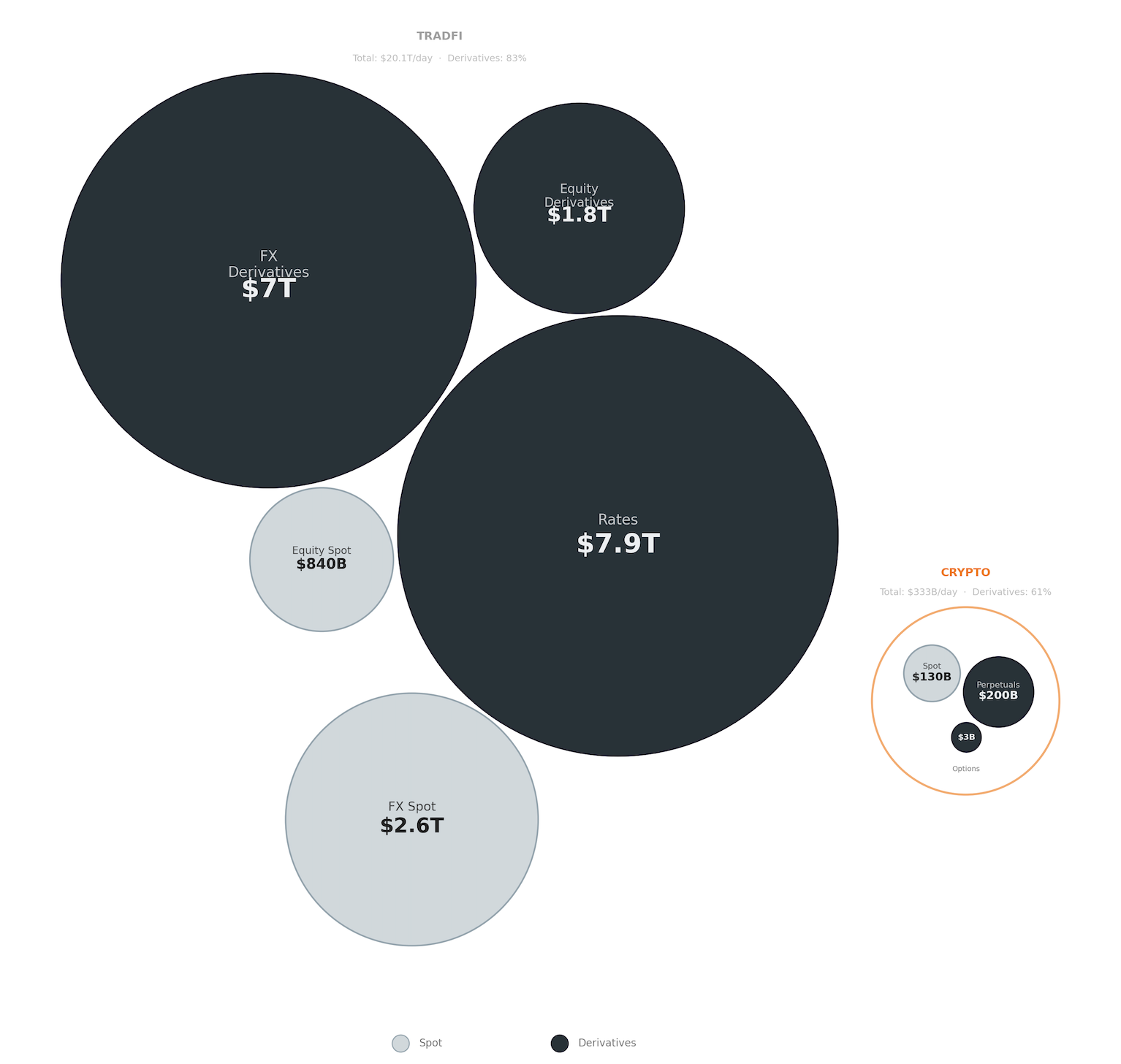 Source: BIS
In crypto, synthetics let you track the price of RWAs without owning them at all. Protocols set up derivative contracts, usually perpetual futures contracts (“perps”) or dated futures, that follow outside prices using oracles. Trader positions are backed by a pool of collateral, and everything settles right onchain, usually in stablecoins or other crypto.
Examples include perpetual futures on RWAs from Hyperliquid, Ostium, and Lighter, as well as prediction markets like Kalshi that now offer binary outcomes on real world events. Both of these markets are both growing extremely fast right now:
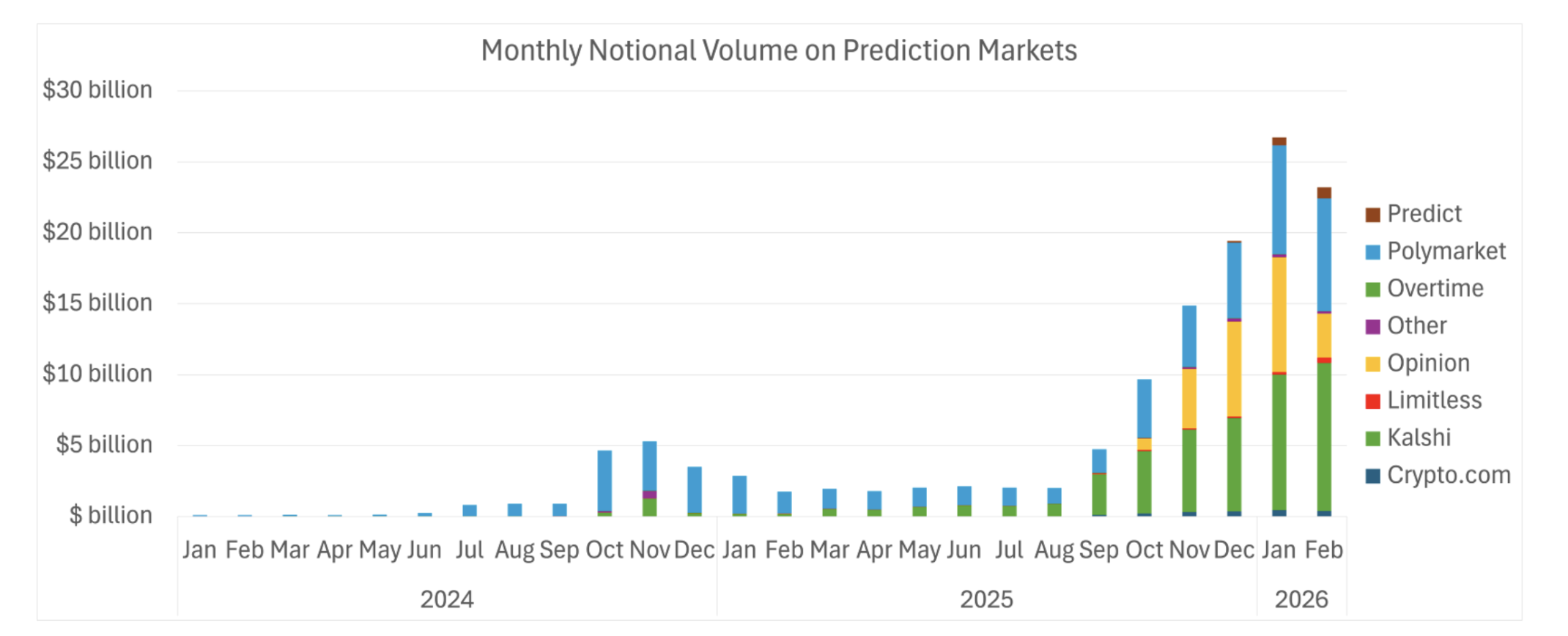 Source: Dune, @datadashboards
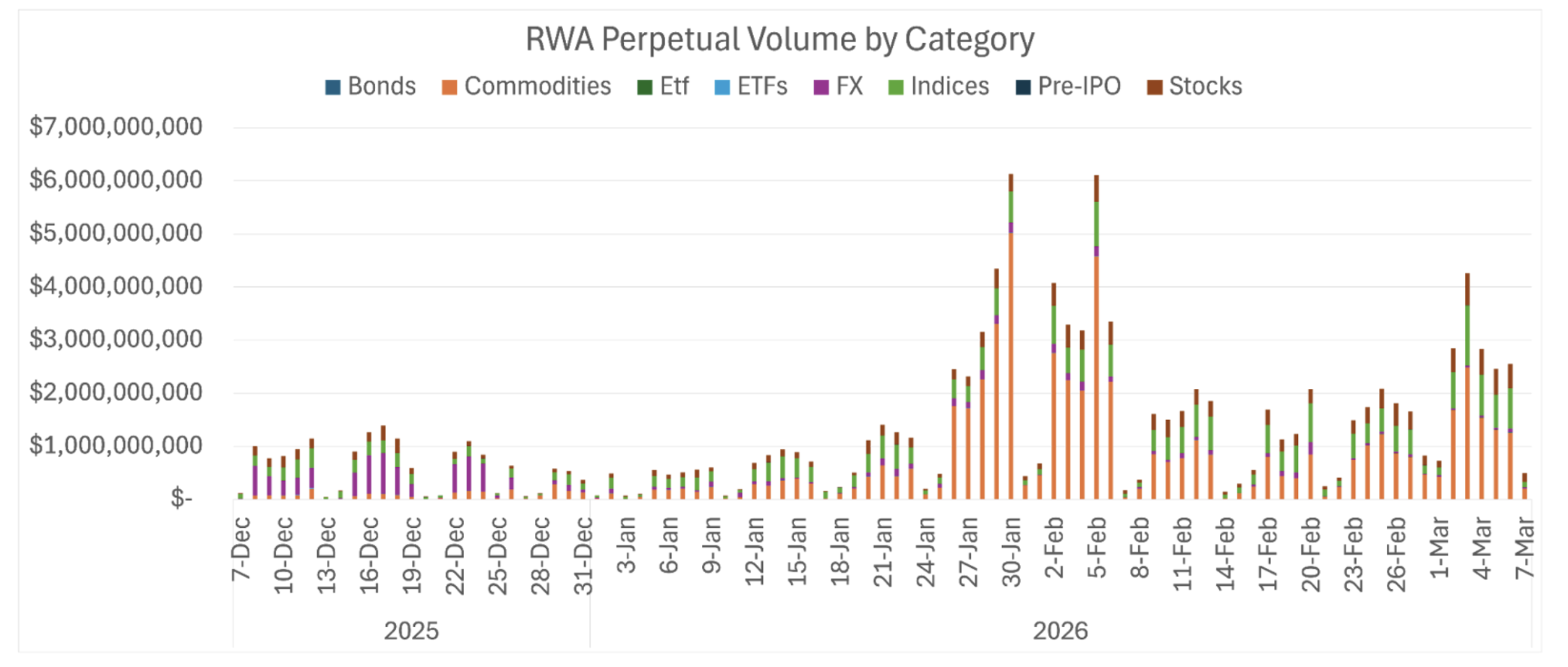 Source: Dune, @yandhii
In our experience, the primary benefit with synthetics is that you can trade them anytime, anywhere. There’s no waiting for markets to open, no need for a middleman, and on top of that everything settles instantly. But there are some trade-offs, namely that traders don’t actually own anything tangible, so they miss out on voting and dividends. Users also have to trust that the price data is accurate, funding rates on perps can eat into returns, and, as a relatively new financial innovation, the rules for them are still nascent.
Model 2 - Wrapped Assets (Custody Model)
The wrapped asset model is an increasingly common approach in crypto today alongside synthetics. The way this works is simple: a regulated entity (fund, SPV, trust, etc.) purchases and holds RWAs offchain, then issues receipt tokens to end users representing fractional claims on the holdings. Token holders can redeem tokens for the underlying asset or cash equivalent, but are subject to redemption windows, minimums, and KYC requirements in a lot of cases.
This model comes in several flavors: direct custody (Dinari’s tokenized stocks), pooled fund shares (Ondo’s OUSG, Franklin Templeton's BENJI), and securitized asset pools (Centrifuge’s invoice financing, Goldfinch’s credit pools).
Model 3 - Collateralized Borrowing
Rather than tokenizing an asset itself, this model uses offchain RWAs as collateral for onchain debt. Borrowers can pledge RWAs like real estate, corporate credit, invoices, etc., and then receive stablecoins in return.
Kamino’s collaboration with Anchorage and Sky’s RWA vaults are an example here. Figure Markets focuses on home equity lines of credit (HELOCs). We believe this is useful for debt purposes, but doesn’t make the collateral useful in a DeFi context outside of the primary application.
This model doesn’t require full tokenization, and it can enable risk tranching. Some downsides are complex legal structures, liquidations through the court system rather than automatically onchain, overcollateralization requirements, and sophisticated risk assessment needs. Also, the collateral is not composable across DeFi.
Model 4 - Primary Onchain Issuance
Rather than wrapping existing assets, issuers create new securities directly on a blockchain. The token is the security itself, not a derivative or wrapper. Importantly, the blockchain would serve as the official book of record, and transfer restrictions and compliance could be enforced at the smart contract level.
This approach obviates the need for a wrapper layer entirely and enables efficient cap table management, real-time settlement possibilities, and programmable compliance. However, it requires regulatory approval for each issuance, works only for new securities, and transfer restrictions limit DeFi composability.
We’re seeing some early experimentation here from crypto natives, like DATs or large CeFi companies that go public, and we expect to see more over time.
We believe this is the purest version of crypto-native RWAs and the industry’s north star generally. Maybe one day we can even get to a world where not only is the asset issued onchain, but settlement happens onchain via stablecoins, too.
Unpacking RWAs Into Defined Asset Classes
In our view, the industry has homogenized “RWAs” into a single category. This intuitively implies that equities, FX, credit, commodities, treasuries, real estate, private credit, money markets, etc. are going to come onchain through the same mechanisms and on the same timeframes. We do not expect that to be the case.
In reality, each asset class has distinct requirements around settlement, custody, liquidity, regulation, transparency, go-to market function, etc. These differences will likely determine when and how an asset eventually moves onchain, which models for bringing them onchain win out, and where liquidity will form.
Let’s look at each asset class and explore how they may come onchain.
Treasuries and Money Market Funds
While t-bills and money market funds are probably the least interesting category here, they have become the dominant sector in RWAs to date. Most onchain money market funds today use some variant of Model 2 (Wrapped Assets), specifically the pooled fund share variant. Some of the more popular examples are Franklin Templeton (BENJI) and Ondo (OUSG).
This model makes sense for a few reasons. First, treasuries can only be held through the Federal Reserve’s book-entry system. Fund structures achieve economies of scale that make the economics work despite thin spreads. And the regulatory path is well-established through existing money market fund regulations.
On a go forward basis, we don't expect treasuries to move beyond Model 2 (Wrapped Assets) anytime soon. Primary issuance onchain would require the U.S. Treasury to issue bonds directly onchain, which seems unlikely in the next several years given how entrenched existing infrastructure is. It’s more realistic that Model 2 (Wrapped Assets) products can perhaps become more efficient and composable, and be more broadly useful in DeFi.
Private Credit
Private credit has emerged as the second fastest growing RWA category after treasuries and money market funds.
A dominant approach is Model 2 (Wrapped Assets, in its securitized pool variant) via teams like Centrifuge, Credix, and Goldfinch. These protocols, generally speaking, structure pools of credit assets and issue tokenized tranches. We see some of Model 3 (Collateralized Loans), where institutional borrowers use offchain credit facilities as collateral for onchain stable loans. Sky RWA vaults are examples here.
Private credit maps well to onchain models because it's less regulated and more fragmented than public securities. There's no centralized infrastructure to fight against; you're just replacing bilateral legal agreements with smart contracts. Model 2 (Wrapped Assets) works for smaller borrowers and consumer/SME credit through pooling and tranching, which, in our experience, is dramatically more efficient than traditional securitization. Model 3 (Collateralized Loans) works for larger institutions who want onchain liquidity without restructuring their entire loan book.
We expect Model 2 (Wrapped Assets) to dominate consumer and SME credit, with potential evolution toward Model 4 (Primary Issuance) where loans are originated directly onchain rather than wrapped.
Equities
Public equities are coming onchain through two models: Model 1 (Synthetics) and Model 2 (Wrapped Assets).
Synthetic perps for stocks have exploded over the past year. Hyperliquid, Ostium, Lighter, and others offer perps on major equities, tracking prices through oracles and settling in stablecoins. Traders get 24/7 access to equity exposure without brokerage accounts or market hour restrictions. Even more interesting is the existence of pre-IPO synthetic trading now, so if you believe the private marks for companies like Perplexity or Anthropic are overpriced, you can short them (although the collateral requirements, funding rates, resolution and payout structures vary by contract and venue).
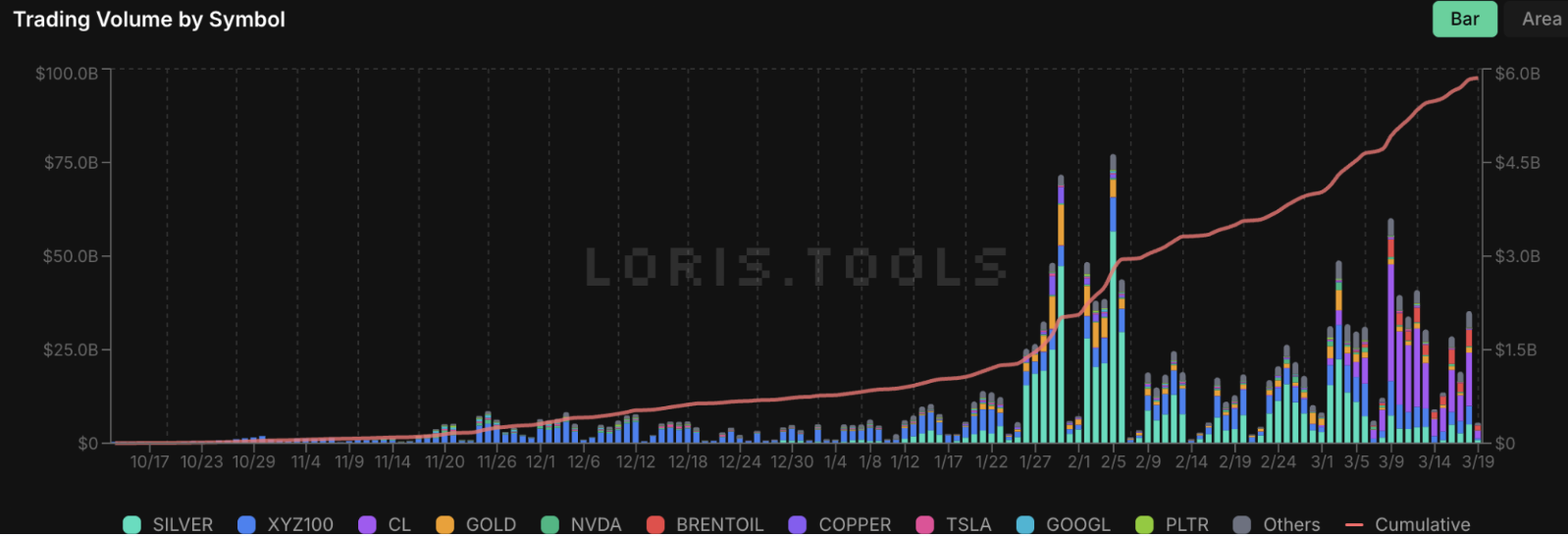 Source: HIP-3 Volumes, loris.tools
The wrapped model also exists but has less traction. Dinari tokenizes actual stocks through a broker-dealer structure and tokens represent real shares held in custody. This gives ownership rights (dividends, voting), but comes with tradfi friction like KYC, geographic restrictions, market hours, and T+1 settlement. It works for investors who want real ownership, but haven’t achieved the scale of synthetics. NYSE and NASDAQ have separately conveyed intent to move more trading onchain through partners like LayerZero and Kraken.
Model 4 (Primary Issuance) for equities means companies would issue stock directly onchain, using tokens as the official share registry. Early instantiations of this are live today in Galaxy’s work with Superstate and Figure’s work on OPEN. At scale, public companies rely on established systems like DTCC, transfer agents, and current stock exchanges. Laws around shareholder rights, proxy voting, and corporate governance are all built for traditional share registries. So essentially corporate law would need to change in key countries before public companies could make this shift.
We believe the more realistic near-term opportunity is for private companies, particularly startups. Cap table management for private equity and venture capital is messy, expensive, and involves intermediaries like Carta. A startup could issue equity directly onchain, with transfers enforced through smart contracts and cap table updates happening automatically. Some platforms like Securitize are building this infrastructure.
Additionally, employees at pre-IPO unicorns often hold illiquid equity. We’re starting to see a bit of experimentation around letting these workers borrow against their equity by pledging it as collateral. We believe this is more practical than tokenizing the shares themselves (which creates securities compliance issues) and solves a real pain point. Some platforms are exploring this, though legal complexity around employee equity restrictions is a real challenge.
Commodities
Commodities are following a similar path to equities, dominated by Model 1 (Synthetics). Perps on gold, silver, oil, and other commodities are widely available on crypto derivatives platforms and are starting to find some amount of product-market fit. Hyperliquid's HIP-3 markets have seen explosive growth in commodities trading, with total open interest reaching a record around $1.34B, driven by assets such as oil (CL), gold, and silver which feature prominently among top contracts alongside equities. Crude oil (CL-USDC) leads in volume with peaks over $1-1.6B in 24-hour trading and open interest around $170-195 million, while gold and silver also rank high in activity.
 Source: Allium
Synthetics are used by two main customer groups. Crypto-native traders look for price exposure and leverage, much like equity perps. At the same time, businesses such as mining companies, energy firms, and agricultural producers need to hedge against changes in commodity prices. For these users, onchain perps can be more efficient than traditional futures since they settle instantly in stablecoins, don’t require margin accounts with CME or ICE, and are available worldwide without intermediaries.
Model 2 (Wrapped Assets) is used for some commodities, especially precious metals. For example, Pax Gold (PAXG) and Tether Gold (XAUT) are tokens backed by real gold stored in vaults. This approach works for gold because it is easy to store and does not spoil. However, wrapped assets are less practical for most other commodities. Oil, natural gas, agricultural goods, and industrial metals are costly to store, can spoil or degrade, and have complicated delivery needs. For these, synthetics make a lot more sense.
The big question is whether Model 4 (Primary Issuance) ever makes sense, and realistically this would require commodity title registries to migrate onchain. Warehouse receipts, bills of lading, and proof-of-ownership documents would need to be blockchain-native and legally recognized. Some projects are experimenting with this for commodities and metals in emerging markets (see Uranium Digital), but it's primarily a supply chain and trade finance play rather than a trading venue. Citi’s recent bill-of-exchange tokenization effort on Solana is a strong example of this. We believe for actual hedging and speculation, synthetics will remain dominant because businesses need cash settlement, not physical delivery.
There are some digitally native commodities that are coming like blockspace, bandwidth, and compute. These are fundamentally different from physical commodities because they're native to digital infrastructure and can settle entirely onchain. Compute marketplaces like Akash and io.net tokenize GPU hours, decentralized storage networks like Filecoin and Arweave commoditize storage, and DoubleZero and Pipe commoditize bandwidth, and Fuse commoditizes energy consumption at the edge. These naturally fit Model 4 (Primary Issuance) because there's no physical custody required. We expect this category to grow significantly as AI compute demand increases and Web3 infrastructure matures.
Our view is that synthetics will continue to dominate physical commodities, with potential to capture real hedging flow from commodity producers and consumers. Model 2 works for easily-stored commodities like gold. Model 4 might emerge for supply chain use cases, but not for financial trading outside the context of digital commodities.
Foreign Exchange
Most onchain Foreign Exchange (FX) today uses Model 1 (Synthetics), and that’s probably not going to change anytime soon. Stablecoins already make it easy and inexpensive to settle major currencies quickly. USDC, USDT, EURC, and other fiat-backed stablecoins are basically digital stand-ins for dollars and euros, and they settle instantly onchain. If you want to move between currencies, you can just swap stablecoins on a DEX or trade synthetic FX pairs on derivatives platforms.
The traditional FX market handles over $7 trillion each day, mainly because cross-border payments and currency exchanges are slow and costly through banks. Onchain systems remove much of this hassle. For example, a business in Brazil can keep USDC, quickly swap it for EURC when they need euros, and pay a European invoice, all without using the traditional FX system.
There is an interesting and mostly untapped opportunity in long tail currencies. While USD and EUR stablecoins are already well-established, most emerging market (EM) currencies still lack liquid onchain versions. Demand is growing for stablecoins tied to currencies like the Brazilian real, Mexican peso, Indian rupee, Nigerian naira, and others. If these stablecoins gain enough liquidity, onchain FX markets could start to compete with traditional FX for cross-border payments in developing economies. However, many of these countries have capital controls or regulations that make it hard to launch compliant fiat-backed stablecoins. As a result, we are seeing experiments with synthetic options, such as algorithmic stablecoins or overcollateralized models, which track these currencies without needing direct fiat reserves.
In the future, if governments relax controls, we might see onchain FX spot markets, with liquidity comparable to traditional FX desks at banks or OTC dealers, using fiat-backed EM stablecoins. Teams like Hibachi and OpenFX are trying to build this future.
Synthetic perps are becoming popular for leveraged FX trading. Some platforms now offer perps on currency pairs like USD/JPY or EUR/GBP, with cash settlement in stablecoins. This lets traders get FX exposure without needing to onboard to CFD brokers which often charge exorbitant fees and arbitrarily rate-limit withdrawals.
In our assessment, Model 2 (Wrapped Assets) doesn't make much sense for FX because stablecoins already are wrapped fiat currencies. Circle holds dollars in reserve and issues USDC, and that's functionally the same structure as wrapped treasuries, just with cash instead of bonds.
Model 4 (Primary Issuance) would mean using central bank digital currencies (CBDCs). Many central banks are testing these, but most CBDCs are permissioned and don’t work well with DeFi. Even if CBDCs become available, we think third party issued stablecoins will stay popular with crypto users because they are easier to use and will likely have fewer restrictions.
In our view, on-chain FX is mostly "solved" for major currencies thanks to stablecoins and synthetic assets. The real opportunity now is to expand into less common emerging market (EM) currencies for spot trading, using either compliant fiat-backed stablecoins or synthetic options. This could make remittances easier, for example by letting people trade HKD/PHP directly without having to convert into and out of USD.
Real Estate
Real estate is one of the hardest major asset classes to bring onchain, and progress has been slow even after years of exuberance about it. The two most common approaches we see right now are Model 1 (Synthetics) and Model 2 (Wrapped Assets). Synthetic approaches include Parcl and PricedOut, which offer perpetual contracts that reference median sale values in specific regions as the market index. In this model, properties are held in SPVs or REITs, and tokens represent some amount of fractional ownership. Platforms such as RealT and Lofty let investors buy tokens tied to individual properties or real estate funds, which gives them a share of rental income and any increase in value.
Real estate tokenization faces some unique challenges compared to other RWAs. Properties are difficult to sell quickly, cannot be divided easily, and often involve high transaction costs, local regulations, ongoing maintenance, and complex legal ownership. Even if an apartment building is tokenized, it still requires property management, handling tenants, repairs, taxes, and compliance with local laws. Putting ownership on the blockchain does not solve these problems. While the token may be easy to trade, the property itself remains hard to transfer.
Model 3 (Collateralized Borrowing) has seen some traction. Platforms like Figure Markets and certain Sky vaults let people use real estate as collateral for onchain loans, usually through home equity lines of credit (HELOCs). This works because the property itself stays offchain (the borrower keeps living in their home) and the protocol only takes a lien. If the borrower defaults, the property is liquidated through the usual foreclosure process.
In our opinion, the dream scenario is Model 4 (Primary Issuance), where property titles themselves are recorded onchain and transfers happen through smart contracts. This would eliminate title insurance, escrow services, and weeks-long closing processes. Some countries with less established property registries, particularly in Latin America and parts of Africa, are experimenting with blockchain-based land registries. But in developed markets like the U.S., property law is deeply entrenched at the state and local level. Migrating centuries of property records and legal precedent to blockchain would require coordination across thousands of jurisdictions.
We believe real estate will mostly stay in Model 2 (Wrapped Assets) for now, appealing to investors who want fractional ownership of certain properties. Model 3 (Collateralized Lending) can help unlock liquidity from current holdings, but Model 4 (Direct Issuance) is likely several years away in developed markets. The main challenge is that tokenizing real estate doesn’t fix the basic illiquidity issue. It only puts a liquid layer on top of an asset that’s still hard to trade.
Summary
While the crypto industry has created some confusion by grouping all RWAs together and sharing that view widely, in reality, each asset class is unique, and the process for bringing them onchain will most likely be different:
- Treasuries are already onchain at scale through wrapped fund structures, and that model isn't changing anytime soon because the underlying infrastructure is too entrenched for primary onchain issuance.
- Private credit is split between securitized pools and collateralized borrowing, with potential to move toward native onchain origination as protocols mature.
- Currently, most public equities trading uses synthetic assets, with some activity in the custody model. In private markets, a main opportunity is to unlock liquidity for unicorn company employees and simplify cap tables. In our opinion, the biggest vision for RWAs is likely the direct issuance of public equities onchain.
- Commodities will mostly stay synthetic for price exposure and hedging. However, digital commodities such as compute and storage are a new category that can settle directly onchain.
- We believe FX is essentially solved through stablecoins, with the main opportunity being long tail EM currencies.
- Real estate is still the toughest market since tokenization doesn’t address the basic illiquidity of physical properties.
Path dependency matters enormously in RWAs. Assets with entrenched settlement infrastructure (treasuries, public equities) will stay in wrapped models for years, whereas assets with fragmented, relationship-driven markets (private credit, private equity) can leapfrog to onchain models faster. And genuinely new digital commodities can be natively onchain from day one.
We’re actively interested in all of these categories, and if you’re building out these primitives we’d love to chat. Reach out to us on X at @shayonsengupta and @spencerapplebau.
In our next post in our market microstructure series, we’re going to discuss why DeFi has historically been capital inefficient on a relative basis. We’ll examine the various ways builders can start improving efficiency across the DeFi stack via products like superprotocols and DeFi prime brokerages.

/Internet Labor Markets

There are only two ways to onboard to crypto: you buy in or you earn in. A buyer explicitly swaps fiat/traditional assets into crypto assets or onto crypto rails. An earner gets paid for work, receiving cryptoassets.
Disclosure: Unless otherwise indicated, the views expressed in this post are solely those of the author(s) in their individual capacity and are not the views of Multicoin Capital Management, LLC or its affiliates (together with its affiliates, “Multicoin”). Certain information contained herein may have been obtained from third-party sources, including from portfolio companies of funds managed by Multicoin. Multicoin believes that the information provided is reliable and makes no representations about the enduring accuracy of the information or its appropriateness for a given situation. This post may contain links to third-party websites (“External Websites”). The existence of any such link does not constitute an endorsement of such websites, the content of the websites, or the operators of the websites.These links are provided solely as a convenience to you and not as an endorsement by us of the content on such External Websites. The content of such External Websites is developed and provided by others and Multicoin takes no responsibility for any content therein. Charts and graphs provided within are for informational purposes solely and should not be relied upon when making any investment decision. Any projections, estimates, forecasts, targets, prospects, and/or opinions expressed in this blog are subject to change without notice and may differ or be contrary to opinions expressed by others.
The content is provided for informational purposes only, and should not be relied upon as the basis for an investment decision, and is not, and should not be assumed to be, complete. The contents herein are not to be construed as legal, business, or tax advice. You should consult your own advisors for those matters. References to any securities or digital assets are for illustrative purposes only, and do not constitute an investment recommendation or offer to provide investment advisory services. Any investments or portfolio companies mentioned, referred to, or described are not representative of all investments in vehicles managed by Multicoin, and there can be no assurance that the investments will be profitable or that other investments made in the future will have similar characteristics or results. A list of investments made by venture funds managed by Multicoin is available here: https://multicoin.capital/portfolio/. Excluded from this list are investments that have not yet been announced due to coordination with the development team(s) or issuer(s) on the timing and nature of public disclosure. Separately, for strategic reasons, Multicoin Capital’s hedge fund does not disclose positions in publicly traded digital assets.
This blog does not constitute investment advice or an offer to sell or a solicitation of an offer to purchase any limited partner interests in any investment vehicle managed by Multicoin. An offer or solicitation of an investment in any Multicoin investment vehicle will only be made pursuant to an offering memorandum, limited partnership agreement and subscription documents, and only the information in such documents should be relied upon when making a decision to invest.
Past performance does not guarantee future results. There can be no guarantee that any Multicoin investment vehicle’s investment objectives will be achieved, and the investment results may vary substantially from year to year or even from month to month. As a result, an investor could lose all or a substantial amount of its investment. Investments or products referenced in this blog may not be suitable for you or any other party. Valuations provided are based upon detailed assumptions at the time they are included in the post and such assumptions may no longer be relevant after the date of the post. Our target price or valuation and any base or bull-case scenarios which are relied upon to arrive at that target price or valuation may not be achieved.
Multicoin has established, maintains and enforces written policies and procedures reasonably designed to identify and effectively manage conflicts of interest related to its investment activities. For more important disclosures, please see the Disclosures and Terms of Use available at https://multicoin.capital/disclosures and https://multicoin.capital/terms.