
There are only two ways to onboard to crypto: you buy in or you earn in. A buyer explicitly swaps fiat/traditional assets into crypto assets or onto crypto rails. An earner gets paid for work, receiving cryptoassets.
Over the past decade, people largely followed the first route. In the next decade, we believe that the majority will be through the second.
If we are correct, this second wave will dwarf the first in both the sheer number of participants and the total volume because the vast majority of people in the world live off of income, not asset purchases or appreciation. As this happens, we believe a critical second-order effect will emerge: earnings will become balances, balances will become savings, and savings will become new participation in Internet Capital Markets.
Programmable Ownership Supercharges Coordination
Today, behemoths such as SpaceX, Scale and Deel already pay out offshore employees and contractors using stablecoins and dollars. This is a secular trend that should continue, but there is an ever larger cohort of individuals that is also earning newly-issued, crypto-native capital assets. Today, it is our understanding that this income is mostly augmentative, and not the primary source of income. But as this design space matures, I believe this means of earning will become the primary source of income for large, globally distributed cohorts of contributors.
Crypto’s superpower has always been coordination. The first example was Bitcoin: one very specific compute primitive (hashing) run everywhere to produce a single ledger. Then came DePIN/DeVIN: networks like Filecoin that mapped new types of work to tokens and let permissionless participants bootstrap supply by doing the work themselves. DePIN is among the best expressions of onchain coordination. Networks like Helium and Hivemapper demonstrated that builders can leverage crypto capital markets and cryptographic primitives to invert capex, pay for proof of physical work, and use tokens to transfer cold-start risk to early contributors who believe in a project’s vision. DePIN pioneered the prerequisites for onchain coordination: 1) fast, cheap settlement, 2) verifiable outputs, and 3) strong trust and reputation guarantees for supply-side contributors.
Permissionless capital markets make distributed coordination at scale possible. They lower the cost of risk aggregation and let strangers, regardless of location or creed, self-organize around a given objective.
However, they alone aren’t enough. DePINs must also build around other considerations to scale permissionless coordination, and, fortunately, they have significantly evolved over the last few years.
First, DePIN founders have gotten much better at incentive design as a whole. In the past, we’ve seen that DePINs have suffered from poorly designed inflationary reward mechanics and anti-fraud systems that prevent parties from spoofing their proof-of-work; however, through collective trial-and-error, market leaders developed emergent sets of best practices. DePINs are also now much more rigorous about work verification (via primitives like zkTLS), spam resistance (elegant bonding/slashing mechanisms), and rewards commensurate with contributed work (e.g., recurring-contribution-based rewards as opposed to time-based, fixed emissions for passive work).
Second, we believe that DePINs have helped to normalize the behavior of earning in tokens. Tens of millions of people today earn crypto for performing specific actions in order to serve some collective objective—e.g., participating in social quests via platforms like Galxe or Kaito, solving bug bounties through platforms like ImmuneFi, or surfacing information through bounties on Arkham.
Third, DePINs have honed the ideal size of a unit of work. We believe that the lackluster durability of general purpose DAOs in the 2021 era demonstrated that the smaller the surface area of contribution, the more effective the network. As a result, networks coordinating simple actions (like setting up miners or base stations) were much more effective than those trying to reinvent capital allocation decision making (e.g., the LAO).
It appears as though we are now entering the next phase of this design space, in which DePINs and other organizations can be substantially more precise about the specificity unit of the work they are offering and the exact reward associated with it.
This means that the spec for a given workload shifts from passive contributions like “put up a WiFi hotspot in a nearby coffee shop, and receive tokens indefinitely” to “deliver this package from point A to point B, and earn a fixed reward,” or “reduce your energy consumption by 100KW within the hours of 7-10PM, and earn tokens that can be used to discount your next electricity bill”.
I believe AI will supercharge this trend and accelerate onchain coordination even faster than what the market presently observes. AI compresses the cost and latency of building software—i.e., one person can ship product, iterate, and reach distribution with a fraction of the headcount that used to be required. The result is that companies can be started by fewer people, and can hit scale faster.
These “thin” organizations however still depend on non-software inputs—i.e., data, labeling, evaluation, integrations, distribution, physical deployment, domain expertise, edge-case handling. Across these functions, inputs are intermittent, global, and hard to hire for in a traditional way.
What used to be a single occupation is now a portfolio of small, modular roles across unrelated domains. Taxi drivers are now rideshare operators within the Uber network, newspaper editors are now authors within the Substack and X networks, USPS employees now deliver on Doordash, and increasingly, remote teleoperators are operating urban, semi-autonomous robotics fleets.
We believe the pattern is clear: technology lowers the cost of coordination and shrinks the atomic unit of work. When coordination costs fall, risk-sharing improves, firms unbundle, and jobs decompose into discrete roles and functions that can be outsourced and coordinated programmatically.
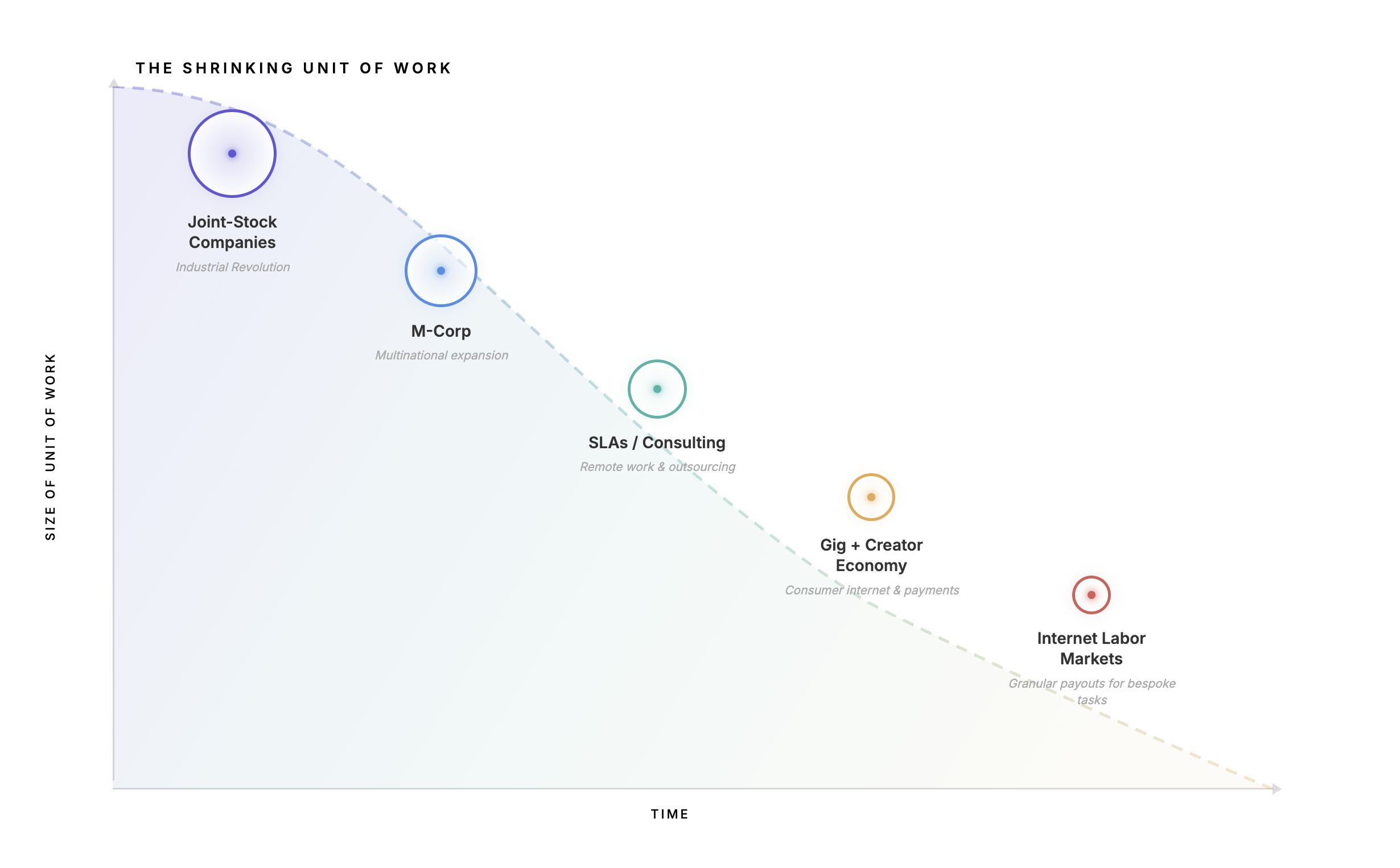
The risk-sharing infrastructure needed for this style of work is best serviced by programmable incentives on crypto rails. Crypto capital markets and cryptographic primitives can help define workloads, verify their completion, and settle rewards and payouts by creating markets around them. AI shrinks the firm, but tokens scale contributors. We’re already seeing one-person organizations reach nine-figure outcomes.
This is the beginning of Internet Labor Markets.
Internet Labor Markets
An Internet Labor Market (ILM) is a contributor-owned marketplace where the unit of work is a verifiable task, settled instantly over crypto rails. In contrast to classical DePINs, the two critical characteristics of such networks are the ability to coordinate Arbitrarily Bespoke Inventory, and reward or pay contributors on a per-contribution basis through Strong Verification Guarantees.
Arbitrarily Bespoke Inventory
We think that the defining feature of an ILM is that work is represented as task primitives that can be created, priced, and retired dynamically as the network’s needs change. A platform built around fixed categories forces novel and emergent work into pre-existing forms, and that mismatch shows up as poor specs, inconsistent quality, and high coordination overhead.
In an ILM, inventory is defined on an ongoing basis through a small set of parameters—e.g., a task specification, eligibility constraints, a verification method, and a payout function. Once parameters are set, tasks can be broadcasted to the world, filled through competition or assignment, confirmed through cryptographic verification, and paid out over crypto rails. This is why ILMs are well-suited to frontier work—because frontier work rarely fits traditional definitions for long periods of time.
An ILM can post “task: collect 200 high-signal edge cases for a specific medical workflow, each with a citation and structured metadata; eligibility: doctor; verification: medical credentials and XLM file; reward: 100 tokens,” and then gate eligibility to contributors with demonstrated domain competence and high historical accuracy. A security market can post “produce a minimal reproducible exploit for contract version X and submit a patch that passes the test suite,” and then pay only upon deterministic verification of the patch plus adjudicated verification of exploit severity. A physical network can post “visit location X, capture timestamped photos, and verify operating hours,” and then combine geofencing proofs with audit-based review for ambiguity. In each case, the underlying marketplace does not need a new category page or a new workflow, because the task definition carries the workflow.
This flexibility compounds over time, because a network can evolve what it purchases as its bottlenecks change, while retaining the same contributor base, verification layer, and reputation system as reusable infrastructure.
Strong Verification Guarantees
In traditional employment systems flow is rote: submit work, issue an invoice, invoice approval, payment initiation, and settlement landing a few days later. That flow seems to be acceptable for large, infrequent deliverables, but we believe it breaks down for high-frequency, adversarial work, because the overhead of processing the work becomes more expensive than the work itself (see, e.g., the medical insurance system).
An ILM replaces that flow with a deterministic verification, which enables instant settlement without the need for human discretion. For example, GPS traces can be checked for plausibility and route matching in mapping networks, such as Hivemapper and Nosh. Code submissions can be verified against a predefined test suite in bug bounty systems, such as ImmuneFi. Model evaluation tasks can be scored against a baseline on a holdout set when the test harness is well-defined in networks like Crunch.
There will, however, always be some set of contributions where human review is necessary. Livepeer pioneered the work-token model, in which contributors post collateral, reviewers are rewarded for accuracy, and both contributors and reviewers who behave adversarially can be penalized through slashing mechanisms. This style of bonded verification does not eliminate fraud, but it creates a sufficient deterrent.
Most ILMs will combine both regimes, because deterministic verification solves the processing problem and bonded verification creates a solution for disputes and qualitative edge cases.
Mapping the Design Space
We map ILMs on three dimensions.
Dimension 1: Task Granularity × Payout Frequency
The size of individual tasks and how frequently contributors receive payment are two of the most crucial inputs into an ILM. Task Granularity sets how much overhead should be spent on specification, verification, and adjudication per unit of work. Payout frequency sets the contributor working-capital burden and determines whether the system behaves like contracting, bounties, shift work, or a task exchange.
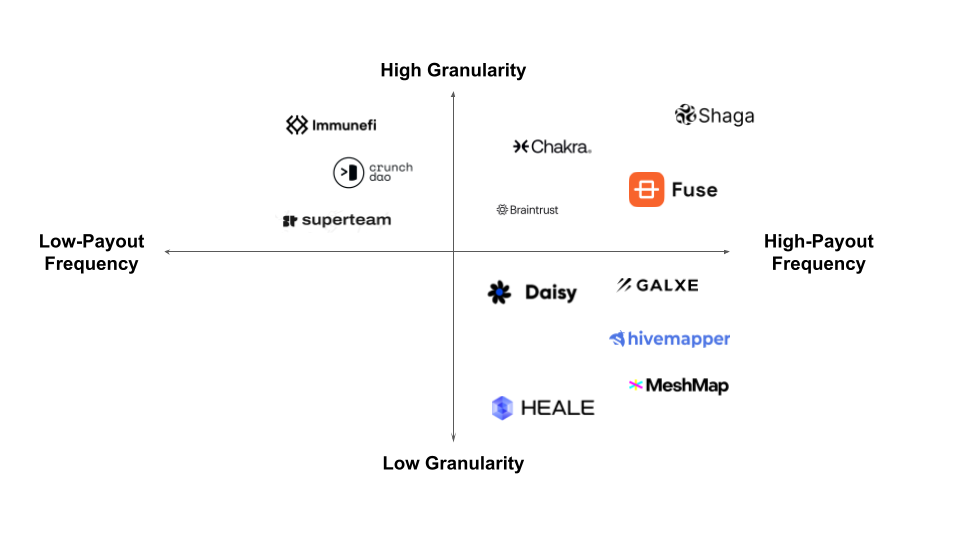
Large tasks with low settlement frequency look like crypto-native contracting. The clean examples are one-off, high-context deliverables i.e., “write and ship this integration,” “perform a security review and produce a report,” “build a dataset and document collection methodology,” or “draft a compliance policy and controls checklist.” Verification is partially subjective, so credibility of reviewers/arbiters and portable reputation are required.
Large tasks with high-frequency settlement look like bounties: rewards are fixed ex ante, and the platform has some form of cryptographic or adjudicated form of acceptance. Examples: bug bounties and vulnerability disclosure; “beat this model on a benchmark;” “produce a working exploit or patch that passes the test suite;” or “find and document 200 high-quality edge cases with sources.”
Small tasks with high-frequency settlement start to look like an exchange: throughput, spam resistance, and verification latency are most important. For example: micro-evals for model outputs (“is this medical reasoning safe,” “is this legal claim valid,” “does this answer cite the right sources”); rapid data validation (“does this screenshot match the claim,” “is this GPS trace plausible,” “does this receipt correspond to this transaction”); small labeling tasks (“classify this image,” “tag this paragraph”). These only work with near-instant settlement and deterministic verification, with adjudication reserved for edge cases.
Dimension 2: Verification Method × Work Domain
This is the second segmentation of the ILM design space, which we believe produces four quadrants with meaningfully distinct marketplace requirements.
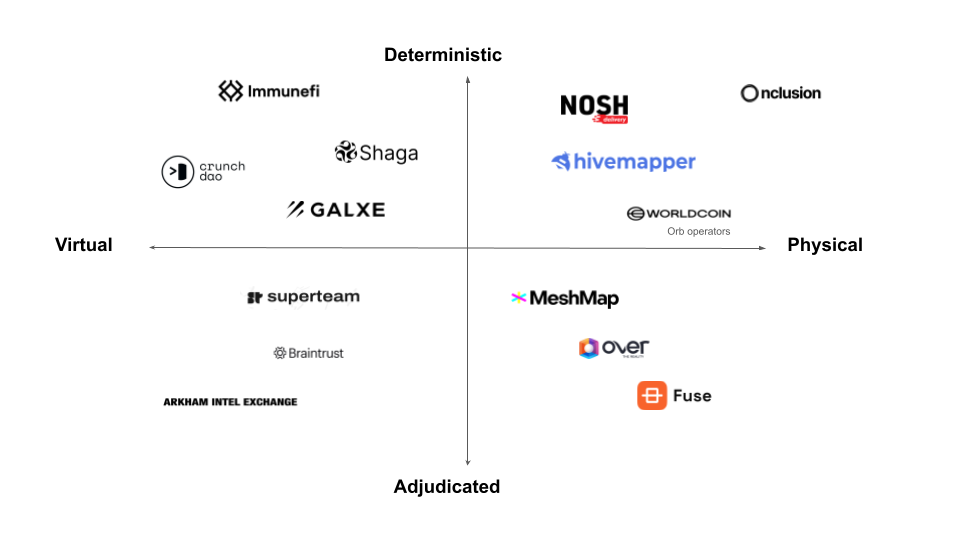
The Virtual + Deterministic quadrant has the lowest verification overhead, but this ease of verification also means the weakest defensibility. Anyone with sufficient capital can spin up a competitive market and compete for the same contributor base. Defensibility in this quadrant comes from trust, reputation, and demand-side relationships rather than the verification infrastructure itself.
The Physical + Deterministic quadrant requires substantial investment in hardware attestation and cryptographic-proof infrastructure, which is harder to replicate and creates a more durable competitive advantage. Networks such as Hivemapper and Geodnet benefit from the fact that their verification systems are genuinely difficult to build.
The adjudicated quadrants require building reviewer networks, which is itself a second-order coordination problem layered on top of the primary ILM contributor network. This process is hard, but once the reviewer network reaches sufficient scale and quality, it becomes a powerful piece of defensibility — you cannot simply fork the protocol and expect the reviewers to follow. The Physical + Adjudicated quadrant is the hardest quadrant to scale because it requires boots on the ground and review infrastructure, but it is also the most defensible once built. Networks operating here face less competition precisely because the barriers to entry are so high (see, Daylight or Nosh).
Dimension 3: Contributor Skill × Payout Frequency
The third dimension concerns the contributors themselves: what skills they bring to the network, and what financial constraints shape their participation. Getting this dimension wrong is perhaps the most common failure mode in ILM design, because it leads to compensation structures that are fundamentally misaligned with contributor needs.

High-skill contributors split into “believers” and “professionals.” Believers underwrite upside and accept token-heavy rewards, vesting, and even staking when ownership maps cleanly to value creation. Consider elite security researchers who prefer a large token bounty over a smaller cash fee, or domain experts contributing to a network’s evaluation standards because they want long-term ownership and reputation. Professionals require predictable settlement; token upside can be additive, but not the wage. Examples include physicians or nurses doing medical evaluations, lawyers reviewing reasoning and citations, or senior engineers doing code review or incident response. These cohorts will not routinely accept token-only rewards for high-stakes work.
Lower-skill contributors split into “accumulators” and “wage earners.” Accumulators are usually part-time and compounding-oriented. Examples include mapping contributors driving routes on weekends, people collecting long-tail local data (store hours, menu photos, and pricing) for a network, and operators maintaining uptime on a device or node. Wage earners are liquidity-constrained and require more price certainty and fast payouts. Examples include field installers doing “go to site A, mount device B, upload proof”; delivery/errand style tasks; and customer visits and verification checks in emerging markets. At scale, “earning as the onramp” implies stablecoin-first wages with optional ownership layered on top rather than token-only comp that forces paycheck speculation.
AI as the catalyst
The consensus view is that human labor will become less valuable as AI systems become more capable. I take the opposite side. I believe Human labor will flourish, because AI dramatically increases individual leverage and expands the feasible problem set. It does so by decomposing work into smaller units, amplifying the output of capable contributors, and making many forms of contribution both legible and monetizable.
As the cost of creation collapses, the universe of problems that can be pursued expands, and the demand for coordination at the edges increases.
A single founder using modern tooling can now build what previously required a full engineering organization; however, the founder still needs human judgment, human verification, human accountability, and a human presence in the corporeal world. High-stakes decisions still require a responsible party.
The organizational form will have to adapt to this new reality. I expect core teams to shrink, and the perimeter of on-demand contributors is going to radically expand. This new reality requires new coordination infrastructure, because the limiting factor is no longer “how many employees can we hire?”, but rather “how quickly can we source, verify, and pay for marginal contributions?”
These AI-enabled organizations will have labor requirements structurally misaligned with traditional labor markets.
First, they will need frontier human feedback. As models improve, the feedback they require becomes more specialized and higher judgment. The question stops being “which response is better” and becomes “is this legal reasoning valid,” “would a doctor actually recommend this,” or “does this code introduce a security vulnerability.” The RLHF bottleneck is real, and it widens as models are deployed into higher-stakes domains. Data and feedback providers have built enormous businesses here, but demand is compounding faster than supply.
Second, they will need agent supervision. As agents become more autonomous, they will still require humans for direction, exception handling, output verification, and high-stakes sign-off. The agent becomes a task router. It escalates to humans when judgment is binding, when accountability matters, or when ambiguity cannot be resolved mechanically. ILMs become the standing labor pool that agents draw from.
Third, they will need physical-world execution. AI can reason about the physical world, but it cannot act in it. Installations still need to be completed. Sensors still need to be deployed. Customers still need to be visited. Hardware still needs to be handled. We believe this is where DePIN and ILMs converge: programmable incentives coordinate real-world work, while verification ensures that rewards remain tied to genuine output.
Fourth, they will need verification at scale. As more activity moves through automated systems, the volume of meta-work increases. Someone has to check that the system behaved correctly, arbitrate disputes, detect fraud, and establish ground truth when machines disagree. This is not a transitional requirement. It scales with the amount of automation, because automation increases throughput and expands surface area.
Within the next year (or perhaps months), we believe we will all witness the emergence of internet-native organizations staffed by internet-native labor. Companies become smaller at the center and broader at the edge. Contributors become more global, more modular, and more interchangeable, all because work is defined as verifiable tasks rather than long-lived roles. As earning moves onchain, earning naturally flows into spending. Once people have balances and familiarity with crypto rails, we believe they will begin to use its native financial primitives: yield, collateral, lending, trading, portfolio construction, etc. This completes the loop from Internet Labor Markets to Internet Capital Markets. It also changes who gets onboarded. The marginal participant is not the person who wakes up and decides to read a white paper or buy a memecoin. The marginal participant is the person who completes work, receives payment, and opts into the system because it pays them best.

/Adverse Selection Rules Everything Around Me


Onchain liquidity has mostly evolved by focusing on one thing at a time. Early on, the main goal was simply to have a counterparty for takers without (a) having to post bids in a central limit order book (CLOB) on Ethereum (where that's not feasible)...
Disclosure: Unless otherwise indicated, the views expressed in this post are solely those of the author(s) in their individual capacity and are not the views of Multicoin Capital Management, LLC or its affiliates (together with its affiliates, “Multicoin”). Certain information contained herein may have been obtained from third-party sources, including from portfolio companies of funds managed by Multicoin. Multicoin believes that the information provided is reliable and makes no representations about the enduring accuracy of the information or its appropriateness for a given situation. This post may contain links to third-party websites (“External Websites”). The existence of any such link does not constitute an endorsement of such websites, the content of the websites, or the operators of the websites.These links are provided solely as a convenience to you and not as an endorsement by us of the content on such External Websites. The content of such External Websites is developed and provided by others and Multicoin takes no responsibility for any content therein. Charts and graphs provided within are for informational purposes solely and should not be relied upon when making any investment decision. Any projections, estimates, forecasts, targets, prospects, and/or opinions expressed in this blog are subject to change without notice and may differ or be contrary to opinions expressed by others.
The content is provided for informational purposes only, and should not be relied upon as the basis for an investment decision, and is not, and should not be assumed to be, complete. The contents herein are not to be construed as legal, business, or tax advice. You should consult your own advisors for those matters. References to any securities or digital assets are for illustrative purposes only, and do not constitute an investment recommendation or offer to provide investment advisory services. Any investments or portfolio companies mentioned, referred to, or described are not representative of all investments in vehicles managed by Multicoin, and there can be no assurance that the investments will be profitable or that other investments made in the future will have similar characteristics or results. A list of investments made by venture funds managed by Multicoin is available here: https://multicoin.capital/portfolio/. Excluded from this list are investments that have not yet been announced due to coordination with the development team(s) or issuer(s) on the timing and nature of public disclosure. Separately, for strategic reasons, Multicoin Capital’s hedge fund does not disclose positions in publicly traded digital assets.
This blog does not constitute investment advice or an offer to sell or a solicitation of an offer to purchase any limited partner interests in any investment vehicle managed by Multicoin. An offer or solicitation of an investment in any Multicoin investment vehicle will only be made pursuant to an offering memorandum, limited partnership agreement and subscription documents, and only the information in such documents should be relied upon when making a decision to invest.
Past performance does not guarantee future results. There can be no guarantee that any Multicoin investment vehicle’s investment objectives will be achieved, and the investment results may vary substantially from year to year or even from month to month. As a result, an investor could lose all or a substantial amount of its investment. Investments or products referenced in this blog may not be suitable for you or any other party. Valuations provided are based upon detailed assumptions at the time they are included in the post and such assumptions may no longer be relevant after the date of the post. Our target price or valuation and any base or bull-case scenarios which are relied upon to arrive at that target price or valuation may not be achieved.
Multicoin has established, maintains and enforces written policies and procedures reasonably designed to identify and effectively manage conflicts of interest related to its investment activities. For more important disclosures, please see the Disclosures and Terms of Use available at https://multicoin.capital/disclosures and https://multicoin.capital/terms.